

|
(Hebrew |
|
pronounced: shav-voo-OH-t) |
|
Meaning: [seven] weeks |
||
Date in Hebrew calendar: month Nisan (March-April)
It is identified in the Old Testament as the Feast of Weeks and the Feast of Harvest:
 Feast
of Weeks
Feast
of Weeks
|
"And you
shall observe the Feast of Weeks, of the firstfruits of wheat harvest,
and the Feast of Ingathering at the year's end."
Exodus 34:22 (NKJV) |
Feast
of Harvest
|
"And the
Feast of Harvest, the firstfruits of your labors which you have sown in
the field; and the Feast of Ingathering at the end of the year, when you
have gathered in [the fruit of] your labors from the field."
Exodus 23:16 (NKJV) |
Pentecost
|
"When the Day of Pentecost had
fully come, they were all with one accord in one place."
Acts 2:1 (NKJV) |
|
"And you shall count from the
morrow after the sabbath, from the day that you brought the sheaf of the
wave offering; seven full weeks shall they be, counting fifty days to the
morrow after the seventh sabbath; then you shall present a cereal offering
of new grain to the Lord."
Leviticus 23:15-16 |
Pentecost is one of only three of the seven feasts of Moses which was compulsory for every able male to attend.
|
"Three times a year all your males
shall appear before the LORD your God in the place which He chooses: at
the Feast of Unleavened Bread, at the Feast of Weeks, and at the Feast of
Tabernacles; and they shall not appear before the LORD
empty-handed."
Deuteronomy 16:16 (NKJV) |
|
|
The Feast of Weeks is associated with the birth of Israel and the giving of the Law/Torah in Exodus 19. The Torah was given when they came to Mount Sinai during their desert experience.
Rabbi Irving Greenberg* explains, "The covenant of Israel turns the Exodus into an ongoing process. On Passover, God committed to the covenant by an act of redemption. On Shavuot, standing at Sinai, the Jewish people responded by accepting the Torah. The teaching that guides the way of the Jews, the Torah, became the constitution of the ongoing relationship of God and the Jewish people."
Passover
tells the story of God’s deliverance. The people were slaves in Egypt
until God delivered them out of the house of bondage unto His great
liberty.
Sukkot,
that is, the Feast of Tabernacles (or Booths), is also one of the great
pilgrimage festivals. Sukkot celebrates God’s provision for the people
during their desert wanderings. They lived in temporary dwellings (sukkot,
huts, or tabernacles) and they depended on the Lord for His provision
each day. The cloud provided cover for the Israelites by day, the fire
guided and protected them by night. God provided the manna as the
necessary food provision for their journey. He brought them quail and
gave them water. The tent dwellers in the wilderness experienced God’s
miraculous care.
The
pilgrim festivals, Passover and Tabernacles, recall God’s deliverance from
slavery and providential care in the wilderness. Like Passover and
Tabernacles, during the festival of Pentecost the people of God were
commanded to make a pilgrimage to Jerusalem. It was natural to view
Pentecost as signifying the events associated with Passover and
Tabernacles. This
pilgrimage festival of Pentecost was understood by the Jewish sages as the
next stage in the journey of the ancient Israelites.
They
had been saved from slavery at Passover. They had been preserved in their
desert wanderings in Sukkot.
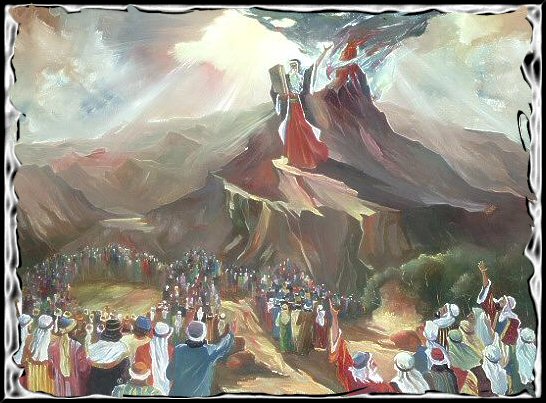 Now
the people of Israel came to Mount Sinai. With peels of thunder and bursts
of lightning, God’s awesome presence was made known as He revealed His
will to the people He loved (Exodus 19-20). God’s revelation in Torah was
given to His people. Pentecost is the "time in which God gave us our
Torah" "zeman matan toratenu". Shavuot
is the anniversary of the giving of the Torah.
It
is also the anniversary of the outpouring of the Holy Spirit upon the
first Messianic believers in Jerusalem:
Now
the people of Israel came to Mount Sinai. With peels of thunder and bursts
of lightning, God’s awesome presence was made known as He revealed His
will to the people He loved (Exodus 19-20). God’s revelation in Torah was
given to His people. Pentecost is the "time in which God gave us our
Torah" "zeman matan toratenu". Shavuot
is the anniversary of the giving of the Torah.
It
is also the anniversary of the outpouring of the Holy Spirit upon the
first Messianic believers in Jerusalem:|
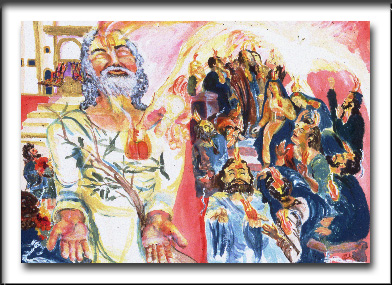
"And when the day of Pentecost [Shavuot]
was fully come, they were all with one accord in one place. And suddenly
there came a sound from heaven as of a rushing mighty wind, and it
filled all the house where they were sitting. And there appeared unto
them cloven tongues like as of fire, and it sat upon each of them. And
they were all filled with the Holy Spirit, and began to speak with other
tongues, as the Spirit gave them utterance." Acts 2:1-4 |
|
"But now
Christ is risen from the dead, [and] has become the firstfruits of those
who have fallen asleep.
But each
one in his own order: Christ the firstfruits, afterward those [who are]
Christ's at His coming."
1Corinthians 15:20,23 (NKJV) |
It
was on Firstfruits, the first Sunday after Passover, when the empty tomb of
Yeshua was discovered. While Israel's risen Messiah was walking the streets of
Jerusalem that day as the firstfruits of the Resurrection, Israel's priests
were in the Temple waving the firstfruits of the barley harvest before a torn
veil that now represented access to the Presence of God through the death of
the Messiah. (See Mt. 27:51 and Heb. 10:19-22) Biblically speaking, the
anniversary of the Resurrection should be called "First Fruits," not "Easter,"
a word derived from the name of the Anglo-Saxon pagan fertility goddess.
Yeshua
remained on earth for forty days after His Resurrection. On the day of His
ascension, He instructed His disciples to wait in Jerusalem for the baptism
of the Holy Spirit. Ten days later, on Shavuot, the anniversary of the giving
of the Torah, Yahweh came again in blazing glory as He had done at Mount
Sinai. But this time He wrote His commandments not upon tablets of stone, but
upon the fleshly tablets of men's hearts, as the prophets had foretold.
(See
Jer.31:31-34;Ezk. 11:19, 20 and 3 6:26f.)
It is no coincidence that the giving of the
Spirit took place on the anniversary of the giving of the Torah. On the day the
Torah was given, the sin of the golden calf caused "about 3,000 men" to be
killed (Ex.32:28).
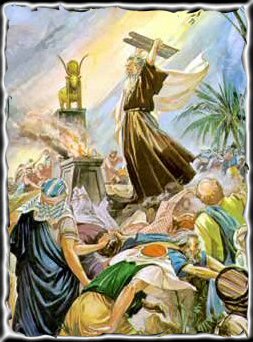
On the day the Spirit was given, the preaching of Peter caused "about 3,000 souls" to find new life in the Messiah (Acts 2:41). This is an excellent illustration of the fact that "the letter [of the Law] kills, but the spirit gives life" (2 Cor.3:6).
|
First Pentecost |
Pentecost After Christ
|
| The Commandments Given | The Holy Spirit Given |
| Fifty days from the crossing of the Red Sea | Fifty days from the resurrection of Christ |
| Law of Yahweh written in Stone | Law of Yahweh written on our hearts |
| Three thousand slain | Three thousand receive salvation |
| The letter of the Law | The Spirit of the Law |
Prophetic Implications
The seven Feasts of Moses are not only commemorative, they are also prophetic.
|
"So let no one judge you in food or
in drink, or regarding a festival or a new moon or sabbaths, which are a shadow of things to come, but the substance is of
Christ."
Colossians 2:16-17 (NKJV) |
The first three, in the month of Nisan, are predictive of the First Coming of Jesus. The last three, in the month of Tishri, are associated with His Second Coming. It is this one, in between, which is associated with the Church.
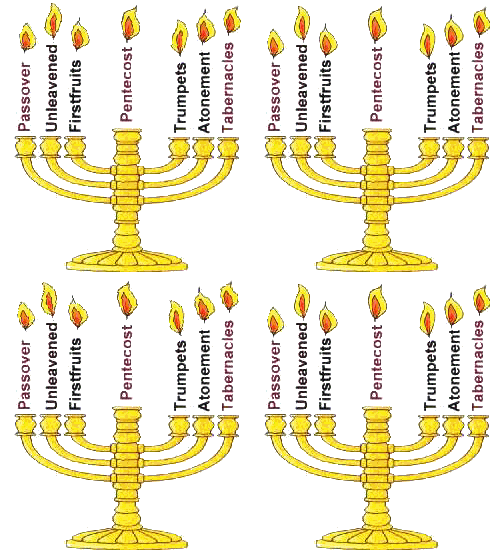
The Birth of the Church
The
Birth of the Church appears to be a fulfillment of the Feast of Pentecost,
or
Shavout.Jesus predicted it...
|
"These
things I have spoken to you while being present with you. 26 But the
Helper, the Holy Spirit, whom the Father will send in My name, He will
teach you all things, and bring to your remembrance all things that I said
to you."
John 14:36-26 (NKJV)
|
It was also fulfilled
precisely on the Feast of Pentecost. Acts
2:1-47
It
is interesting to carefully compare Acts 2 with Exodus 19.
Pentecost
is the only Feast in which
leavened bread is allowed, which seems to
give it a Gentile flavor! (Leaven is always a "type" of sin. Jesus
and Paul both used it this way. It corrupts by puffing up.)
|
"Your glorying [is] not good. Do
you not know that a little leaven leavens the whole lump? Therefore
purge out the old leaven, that you may be a new lump, since you truly are
unleavened. For indeed Christ, our Passover, was sacrificed for us.
Therefore let us keep the feast, not with old leaven, nor with the leaven
of malice and wickedness, but with the unleavened [bread] of sincerity and
truth."
1Corinthians 5:6-8 (NKJV) |
Today
in Israel the Feast of Shavuot is celebrated by decorations with a harvest
theme and the reading of the account of the giving of the Law (Exodus
19-20). The Book of Ruth is also read, as it is a book of harvest and
redemption, ending with the genealogy of King David who...according to
tradition...was born and died on Shavuot.
For
Christians, Pentecost marks the 'firstfruits' of the New Testament
covenant...the first believers in the church of Jesus Christ. It also
celebrates the coming of the Holy Spirit so the law could be written...not
on tablets of stone...but on our hearts.

Shalom and blessings
Billye Jeane/bj


Reference:
Bible Holidays
https://www.grapevinestudies.com/blog/what-are-the-holidays-in-the-bible/
Restoration Foundation http://www.restoremagazine.org/
Koinonia House http://www.khouse.org/
*Rabbi Irving Greenberg played a founding role in the establishment of Jewish Life Network/Steinhardt Foundation. From 2000-2002, Greenberg served as Chairman of the United States Holocaust Memorial Council. An ordained Orthodox rabbi and a Harvard Ph.D. and scholar, Greenberg has been a seminal thinker in confronting the Holocaust as an historical transforming event and Israel as the Jewish assumption of power and the beginning of a third era in Jewish history.
|
|