
The Seven Feasts of Israel

The Appointed Times
HaMoyadim
The Feasts and holy days of God are called,
in Hebrew, HaMoyadim (ha mow ya dimm), the appointed times.
~ God’s Festivals and Christian Faith ~

For those desiring to learn more about the Hebrew Roots of the Christian faith the best place to start is with the system of remembrance practices known as the Feasts of Israel/The Feasts of the Lord.

Genesis 1:14
“And God said, Let there be lights in the firmament of the heaven to divide the day from the night; and let them be for signs, and for seasons, and for days, and years...."
This is where the calendar is started and the word ‘seasons’
means the "appointed times" (HaMoyadim).
God has an appointment calendar just like any successful business person.

There are only 70 specially appointed times for holy days called "HaMoyadim" (the appointed times) in a year, as defined by Leviticus 23*:
1) 52 Sabbaths
2) 7 days of Pesach/Passover (encompassing Passover, the Feast of Unleavened Bread and Feast of First Fruits)
3) 1 day for Hag Ha Shavuot (Feast of Pentecost)
4) 1 day for Yom Teruah (Feast of Trumpets, which is concurrent with Rosh Hashanah ... this and other things will be explained in detail as we study each feast)
5) 1 day for Yom Kippur (Day of Atonement)
6) 7 days for Sukkot (Feast of Booths/Tabernacle)
7) 1 day for Shmini Atzeret (Eighth Day of Assembly)
52+7+1+1+1+7+1=70 specially appointed times
~ HaMoyadim ~
 |
These are times when Elohim, the God of the Universe, has
requested we meet with Him and times that He meets with us. |
|
|
This is not to say we cannot enjoy communing with Elohim/God
at any time we approach Him in faith believing that Blood of Yeshua/Jesus
has given us access. |
|
|
It says that God as a planned
time to meet with us and He dictated the dates and proper observation to
Moses on Mount Sinai. His instructions are recorded in Leviticus
chapter 23*. |
|
|
You wouldn't neglect an
important appointment to meet some world leader…would you? Would you
neglect an appointment with God who has scheduled this in on His calendar? |
|
|
The festivals of the Lord
found in Leviticus 23* were given to us by God so His people could
understand the coming of the Messiah/Mashiach and the role that Messiah/Mashiach
would play in redeeming and restoring both man and the earth back to God
following the fall of man in the Garden of Eden/Gan Eden. |
|
|
Although most Bible believers
have heard of the Feasts, the deep meaning and the importance of these
Feasts are for the most part not understood. |

~ Why Study the Feasts? ~
|
|
We need to remember because we are prone to forget! We are, more often than
not, an ungrateful people like the nine lepers who forgot to go back and thank Jesus for healing
(Luke 17:12-19). |
|
|
We
should be grateful to our Creator for having recognized our tendency to forget
and provided us with an appointment calendar to jog our memory … really! |
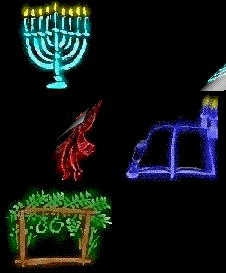
The Feasts are beautiful shadow pictures of God’s redemptive work through His Son.
If you desire a deeper understanding of our Most High Holy God in a greater way than you do today, then the Feasts will reveal to you the deeper things.
~ Feasts Can Foretell the Future ~
|
|
To
understand these Feasts is to understand how God announced in advance how His
Son would pay the penalty for man’s sin. |
|
|
|
Yeshua/Jesus
fulfilled each of these Feasts to the very day and hour, which God’s people had
observed for hundreds of years. |
|
|
|
The Jewish people observed
these Feasts, but few recognized the Messiah when He came. |
|
|
|
Why didn't they recognize their Messiah
when He suffered and died during His appointed time (HaMoyadim)? |
|
|
|
They did
not recognize their Messiah because they had added so many man-made rules and
traditions to God's Law/Torah that they were consumed with their religiosity. |
|
|
|
Can the church learn from the Jewish
people? The church today has basically done the
complete opposite and has gotten the same results. The church has subtracted from God's
Law through our man-made religious doctrine and traditions. |
|
|
|
Remember the words of Jesus in
Matthew 5:17-18:
|
Reference: Chuck Missler: The Appointed Times
1: And the LORD spake unto Moses, saying,
2: Speak unto the children of Israel, and say unto them, Concerning the feasts of the LORD, which ye shall proclaim to be holy convocations, even these are my feasts.
3: Six days shall work be done: but the seventh day is the sabbath of rest, an holy convocation; ye shall do no work therein: it is the sabbath of the LORD in all your dwellings.
4: These are the feasts of the LORD, even holy convocations, which ye shall proclaim in their seasons.
5: In the fourteenth day of the first month at even is the LORD's passover.
6: And on the fifteenth day of the same month is the feast of unleavened bread unto the LORD: seven days ye must eat unleavened bread.
7: In the first day ye shall have an holy convocation: ye shall do no servile work therein.
8: But ye shall offer an offering made by fire unto the LORD seven days: in the seventh day is an holy convocation: ye shall do no servile work therein.
9: And the LORD spake unto Moses, saying,
10: Speak unto the children of Israel, and say unto them, When ye be come into the land which I give unto you, and shall reap the harvest thereof, then ye shall bring a sheaf of the firstfruits of your harvest unto the priest:
11: And he shall wave the sheaf before the LORD, to be accepted for you: on the morrow after the sabbath the priest shall wave it.
12: And ye shall offer that day when ye wave the sheaf an he lamb without blemish of the first year for a burnt offering unto the LORD.
13: And the meat offering thereof shall be two tenth deals of fine flour mingled with oil, an offering made by fire unto the LORD for a sweet savour: and the drink offering thereof shall be of wine, the fourth part of an hin.
14: And ye shall eat neither bread, nor parched corn, nor green ears, until the selfsame day that ye have brought an offering unto your God: it shall be a statute for ever throughout your generations in all your dwellings.
15: And ye shall count unto you from the morrow after the sabbath, from the day that ye brought the sheaf of the wave offering; seven sabbaths shall be complete:
16: Even unto the morrow after the seventh sabbath shall ye number fifty days; and ye shall offer a new meat offering unto the LORD.
17: Ye shall bring out of your habitations two wave loaves of two tenth deals: they shall be of fine flour; they shall be baken with leaven; they are the firstfruits unto the LORD.
18: And ye shall offer with the bread seven lambs without blemish of the first year, and one young bullock, and two rams: they shall be for a burnt offering unto the LORD, with their meat offering, and their drink offerings, even an offering made by fire, of sweet savour unto the LORD.
19: Then ye shall sacrifice one kid of the goats for a sin offering, and two lambs of the first year for a sacrifice of peace offerings.
20: And the priest shall wave them with the bread of the firstfruits for a wave offering before the LORD, with the two lambs: they shall be holy to the LORD for the priest.
21: And ye shall proclaim on the selfsame day, that it may be an holy convocation unto you: ye shall do no servile work therein: it shall be a statute for ever in all your dwellings throughout your generations.
22: And when ye reap the harvest of your land, thou shalt not make clean riddance of the corners of thy field when thou reapest, neither shalt thou gather any gleaning of thy harvest: thou shalt leave them unto the poor, and to the stranger: I am the LORD your God.
23: And the LORD spake unto Moses, saying,
24: Speak unto the children of Israel, saying, In the seventh month, in the first day of the month, shall ye have a sabbath, a memorial of blowing of trumpets, an holy convocation.
25: Ye shall do no servile work therein: but ye shall offer an offering made by fire unto the LORD.
26: And the LORD spake unto Moses, saying,
27: Also on the tenth day of this seventh month there shall be a day of atonement: it shall be an holy convocation unto you; and ye shall afflict your souls, and offer an offering made by fire unto the LORD.
28: And ye shall do no work in that same day: for it is a day of atonement, to make an atonement for you before the LORD your God.
29: For whatsoever soul it be that shall not be afflicted in that same day, he shall be cut off from among his people.
30: And whatsoever soul it be that doeth any work in that same day, the same soul will I destroy from among his people.
31: Ye shall do no manner of work: it shall be a statute for ever throughout your generations in all your dwellings.
32: It shall be unto you a sabbath of rest, and ye shall afflict your souls: in the ninth day of the month at even, from even unto even, shall ye celebrate your sabbath.
33: And the LORD spake unto Moses, saying,
34: Speak unto the children of Israel, saying, The fifteenth day of this seventh month shall be the feast of tabernacles for seven days unto the LORD.
35: On the first day shall be an holy convocation: ye shall do no servile work therein.
36: Seven days ye shall offer an offering made by fire unto the LORD: on the eighth day shall be an holy convocation unto you; and ye shall offer an offering made by fire unto the LORD: it is a solemn assembly; and ye shall do no servile work therein.
37: These are the feasts of the LORD, which ye shall proclaim to be holy convocations, to offer an offering made by fire unto the LORD, a burnt offering, and a meat offering, a sacrifice, and drink offerings, every thing upon his day:
38: Beside the sabbaths of the LORD, and beside your gifts, and beside all your vows, and beside all your freewill offerings, which ye give unto the LORD.
39: Also in the fifteenth day of the seventh month, when ye have gathered in the fruit of the land, ye shall keep a feast unto the LORD seven days: on the first day shall be a sabbath, and on the eighth day shall be a sabbath.
40: And ye shall take you on the first day the boughs of goodly trees, branches of palm trees, and the boughs of thick trees, and willows of the brook; and ye shall rejoice before the LORD your God seven days.
41: And ye shall keep it a feast unto the LORD seven days in the year. It shall be a statute for ever in your generations: ye shall celebrate it in the seventh month.
42: Ye shall dwell in booths seven days; all that are Israelites born shall dwell in booths:
43: That your generations may know that I made the children of Israel to dwell in booths, when I brought them out of the land of Egypt: I am the LORD your God.
44: And Moses declared unto the children of Israel the feasts of the LORD.


|
|